- 1Bench and saltTake the tomahawk out of the fridge 45 minutes before you cook. Pat completely dry with paper towel. Salt generously on all surfaces with flaky sea salt. Rest at room temperature, uncovered — the salt draws moisture out, which then reabsorbs, seasoning the meat deeply.
- 2Low oven firstPreheat your oven to 110°C fan-forced. Place the steak on a wire rack over a baking tray. Insert a digital probe thermometer into the thickest part of the meat, avoiding the bone. Roast until the internal temperature reaches 48°C for a final medium-rare (about 40-45 minutes for a 1.2 kg steak). This is the reverse of the classic 'sear-then-oven' method — cooking low first gives you edge-to-edge pink with no grey band.
- 3Rest before the searPull the steak from the oven and rest on the wire rack for 10 minutes. Don't cover — you want the surface to dry out. Bring a cast-iron pan or your BBQ grill grate to screaming hot in the meantime (250°C+). Cast iron over a high burner works if you don't have a good grill.
- 4Add fat for the searAdd the vegetable oil to the pan and swirl. Once it's shimmering (nearly smoking), lay the tomahawk in gently, away from you. Add the butter, garlic and rosemary/thyme sprigs alongside.
- 5Sear each side hard60-90 seconds each side. Do not fuss with it. As the butter melts, tilt the pan and spoon the foaming butter over the steak — 'basting'. Sear each side (top, bottom, and both the fat cap edges) until you have a deep dark-mahogany crust.
- 6Check final temperaturePull the steak when the internal temp reads 54°C for medium-rare, 58°C for medium. It will climb another 2-3°C while resting. Total sear time is only about 4-5 minutes.
- 7Rest againMove to a warm plate and rest for a full 10 minutes, loosely tented with foil. Resting is not optional. Slicing early spills every drop of the juice you just spent an hour building.
- 8Slice against the grainLook for the direction of the muscle fibres and slice across them at 1 cm thickness. Season the sliced steak with cracked pepper and a scatter of Maldon flaky salt. Serve immediately on a warm platter.
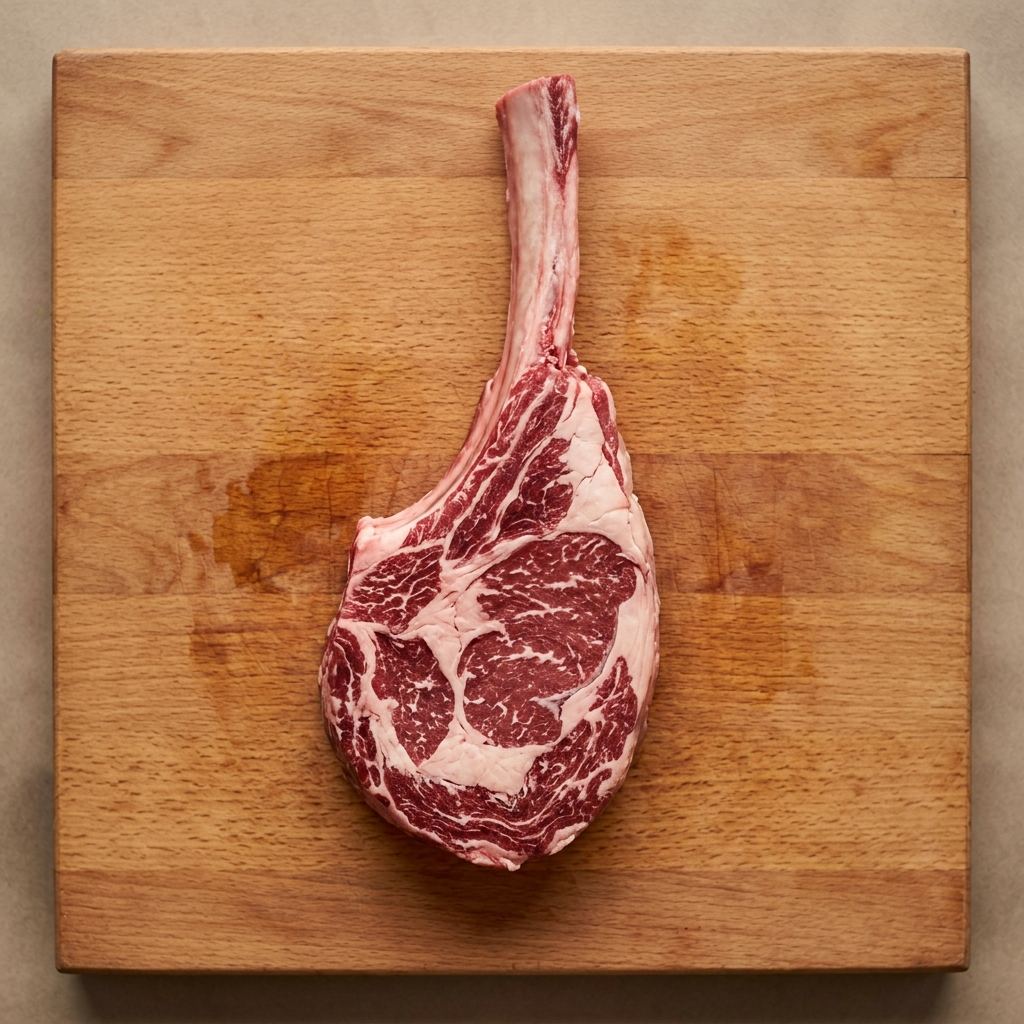
A tomahawk is the theatrical showpiece of any steak dinner — a 1.2-1.5 kg bone-in ribeye with the entire rib bone left in, French-trimmed like a big meaty axe. It's a piece of butchery designed for a table centrepiece: you plate it whole, carve it in front of your guests, and pour red wine while everyone watches.
But: cooking a 5 cm thick steak with a hot pan alone is a recipe for a burnt outside and a raw middle. This is where reverse-searing wins — cook it slowly first in a low oven, then finish with a hard sear at the end. The result is edge-to-edge medium-rare with a dark-mahogany crust. Every Perth restaurant that charges $180 for a tomahawk uses this technique. You can do it at home for $85 with our subscription pricing.
What makes a tomahawk different
- Bone-in. The rib bone conducts heat differently and adds serious flavour to the meat closest to it.
- Thickness. At 5 cm, a tomahawk needs a two-stage cooking method — the pan alone cannot penetrate this thickness evenly.
- Marbling. Cut from the fore-rib section (same primal as ribeye/scotch fillet), tomahawks carry premium marbling.
- Presentation. The frenched bone is what makes this a party cut. Plate it whole on a wooden board and let people admire it before carving.
Our tomahawks come from Australian grass-fed beef, hand-Frenched at our Malaga counter (we scrape the bone clean by hand, not with a machine), and dry-aged for 14 days minimum.
Two-stage cooking, explained
- Stage 1 — Low oven (48°C internal target). Cooking below 110°C means the exterior barely browns, but the interior comes up to a uniform medium-rare temperature. This is the opposite of the traditional method where you sear first — reverse-sear puts the fast, browning step at the end.
- Stage 2 — Screaming-hot sear (final crust). A ripping-hot cast-iron pan or grill grate for 60-90 seconds per side develops a deep Maillard-reaction crust without further cooking the interior.
The result: no grey band under the crust, no raw-cool centre, no guesswork. Edge-to-edge medium-rare pink with a caramelised exterior.
Kit you'll need
- Digital probe thermometer — non-negotiable. Guessing on a $85 steak is madness.
- Cast-iron pan OR a BBQ with a good grill grate
- Oven with fan-forced setting
- Wire rack — sits the steak above the baking tray for airflow
- Warm plate for resting
The sides don't compete
A tomahawk is the star. Do not crowd the plate. Suggested pairings:
- A pile of watercress dressed with lemon and olive oil — the peppery cut is perfect against the fat
- Roasted bone marrow — ask your butcher for a marrow bone next time
- Chunky chips, hand-cut, twice-cooked in dripping if you can be bothered
- Green salad, simple, no strong dressing
The wine
A single big red — nothing else. A Margaret River Cabernet with 5+ years on it, a Barossa Grenache blend, or a proper Coonawarra Cabernet-Shiraz. Skip anything under $30.
Timing for a Saturday dinner at 19:30
- 17:30 — Pull the steak from the fridge, salt it
- 18:15 — Preheat oven to 110°C
- 18:30 — Tomahawk into the oven
- 19:15 — Pull at 48°C, rest 10 min, preheat pan
- 19:25 — Sear 4-5 min total
- 19:30 — Rest 10 min tented
- 19:40 — Slice and serve
Where to source
Australian grass-fed Tomahawk steaks are the hero cut in our Grill Master's Box and available à la carte from the beef page. Delivered fresh across Perth every Friday from our Malaga butchery. Order by Wednesday 7pm.
The tomahawk is a special-occasion steak. Master this method once and you'll never spend $180 at a Perth restaurant to eat one again — you'll cook it better at home for a third of the price, with your favourite wine and your favourite people.